Part 2 of a series. Part 1 is the inspection checklist for the car itself — what to look for before you ever talk price.
Years ago I took one of my daughters to buy a used car. We'd agreed beforehand she'd spend no more than $8,000, and I asked her to let me do the talking. When the dealer asked what price range we were looking at, I told him she'd prefer to stay at $7,000 max — knowing full well he'd try to push us up, and wanting room to absorb that push.
She piped right up: "No, I can spend up to 8!"
Sigh. That killed the tactic dead on the spot. But she learned something that day that stuck — and when we went back years later for her second car, we had that story to lean on. This time we scripted the whole negotiation ahead of time, agreed on it together, walked in aligned, and it played out almost exactly as we'd planned.
That's the real lesson, and it comes before any tactic: decide your numbers and your story before you walk onto the lot, and make sure everyone on your side knows the plan. The dealer negotiates for a living. You don't. The only way to be on equal footing is to not be improvising.
So here's how the game works, and how to play it.
The dealer's first move: "What kind of monthly payment can you afford?"
This question will come early, and it sounds friendly. It is not. It's the single most important move the dealer makes, and the entire negotiation tilts in their favor the moment you answer it.
Here's why. If you say "around $400 a month," the dealer now has a number to build around — and they can hit almost any monthly payment you name while still overcharging you badly. They just stretch the loan longer, bump the interest rate, quietly fold in add-ons, and lowball your trade-in. You walk away thinking you got your number. You didn't. You got their number dressed up as yours.
Your response: focus on total cost, as if you're paying cash
When they ask about monthly payments, say some version of this:
"I'd rather focus on the total cost of the vehicle, assuming a full cash payout."
Then hold there. Do not let the conversation move to monthly payments until the total price of the car is settled and written down. This one move is the whole ballgame. You're forcing the negotiation onto a single honest number — the actual price of the actual car — instead of letting it sprawl across four variables you can't track in your head.
Once that total price is locked, then monthly payments become a real conversation. And it's a simpler one than the dealer wants you to think. The monthly payment depends on two things: how many payments you're willing to take on, and your interest rate. More payments means a lower monthly amount. A lower interest rate means a lower monthly amount. That's it. None of that should change the price of the car — and if you've already nailed the price down, it can't.
Why this also protects your trade-in
There's a second reason to establish the cash price first. If you're trading in a car, the dealer loves to blend everything together — new car price, your trade-in value, financing — into one swirling pile where you can't tell what's happening. They'll "give you a great deal on the trade" while quietly clawing it back on the price of the car.
Settle the vehicle's price first, as its own clean number. Then negotiate your trade-in as its own separate number. Two clean numbers you can actually see. The dealer wants one blurry number. Don't give it to them.
Warranty: the upsell after the deal
Once the price is settled, you're not done — you'll get walked into the finance office, and that's where the extended warranty pitch happens. Understand what this is: extended warranties and service contracts are one of the highest-margin products a dealership sells. The price is not fixed, the urgency is manufactured, and "this offer is only good today" is a sales line, not a fact.
That doesn't make a warranty automatically a bad buy — on some used cars, on some budgets, it's reasonable peace of mind. But treat it as exactly what it is: a separate product, with its own negotiable price, that you decide on with a clear head. Ask what's actually covered and what's excluded. Ask about the deductible. Ask who you take the car to. And know you can always say no and walk out with the car anyway — the warranty was never required to close the deal.
The mindset that ties it all together
Every one of these tactics comes back to the same principle: keep the numbers separate, and keep them visible. The dealer's whole edge is blending price, trade-in, financing, and add-ons into a single fog where you can only see the monthly payment. Your job is to refuse the fog. Price first. Trade-in second. Financing third. Warranty as its own decision, last.
That's what the script was, the second time around with my daughter — every number decided in the driveway before anyone walked onto the lot, and the two of us agreed on exactly how the conversation would go. It worked because nothing about it was improvised.
And the strongest card you hold costs nothing: you can leave. The lot has other customers; you have other lots. A buyer who's genuinely willing to walk away is a buyer who doesn't get played.
One more success story
I've got another daughter, and her turn came too.
First time around, I did most of the talking and then afterward we went back through all of it. What I said. Why I said it. What the dealer was doing right back at me. She soaked it all up.
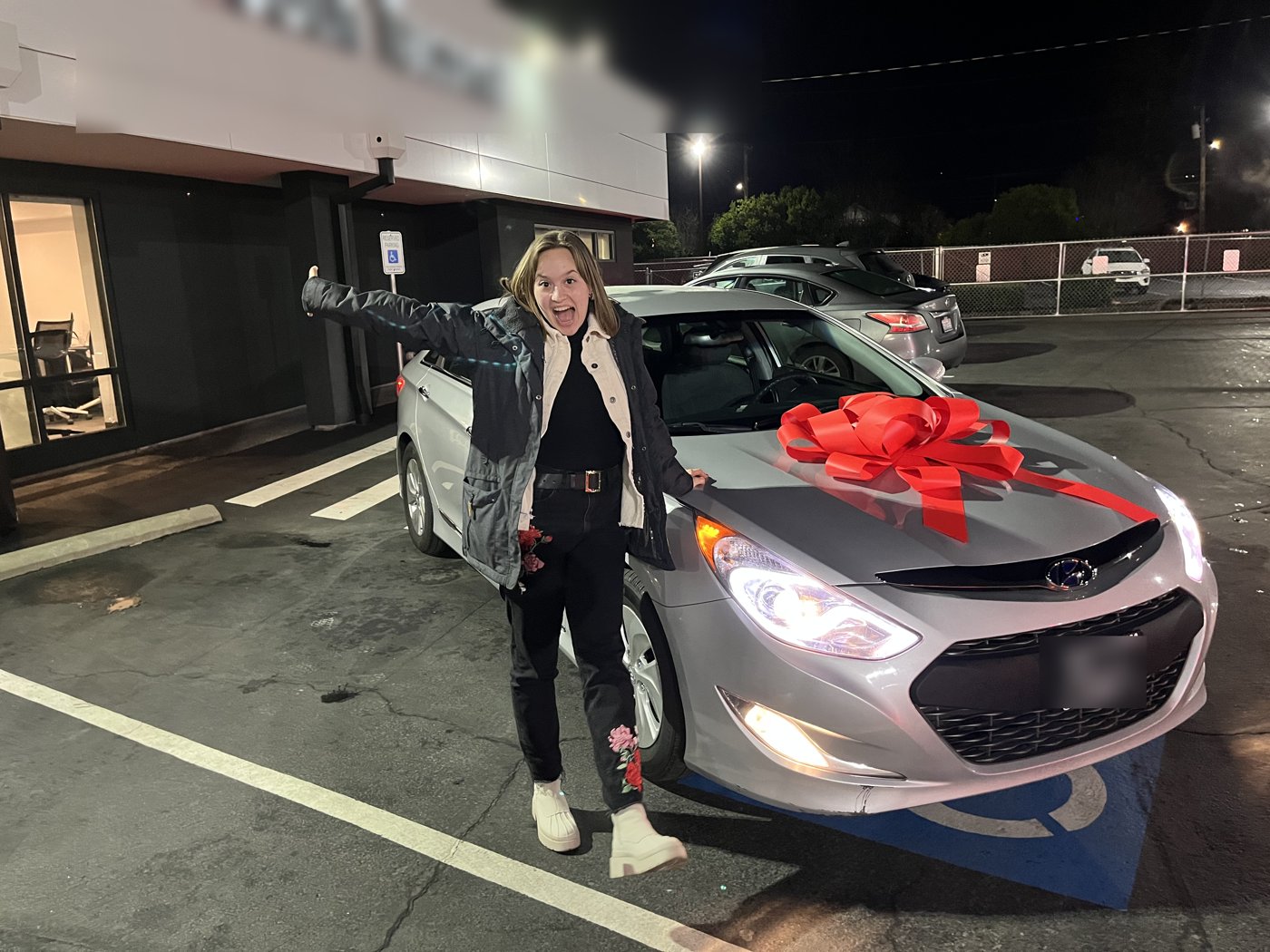
Then a few years later she bought a car on her own. No dad in the chair next to her. She walked in, ran the same playbook, held her numbers, and drove off with a deal she got 100% on her own terms. That's her up at the top of this article — red bow and all. That grin? That's what doing it yourself looks like.
And that's the whole reason I bother writing any of this down... it's so my girls — and you — can walk onto a lot alone and not get played.
Leave a comment