VPN ads promise invisibility, private browsing, anonymous browsing, and protection from hackers. That's not what you're buying, and if you sign up expecting it, you'll end up disappointed or thinking you're protected when you aren't.
A VPN is a service that routes your internet traffic through the VPN company's server before it goes out to the rest of the internet. Here's what that gets you, and what it doesn't.
What a VPN does
It hides which sites you visit from whoever runs the network you're on. The hotel wifi, the airport, the coffee shop, your own ISP at home — none of them can see that you went to your bank, your email, or anywhere else. They just see that you connected to a VPN server.
It also hides your home IP address from the sites you visit. The site sees the VPN server's address instead of yours. That's what lets you appear to be in another country, which is the main reason people use one for streaming — pick a UK server and some services will treat you as being in London. The big streamers actively block VPN addresses though, so it works on some servers and not others, and what worked last month may not work today.
What a VPN doesn't do
The old pitch — "hackers on café wifi will steal your banking password" — is mostly obsolete. HTTPS already encrypts the contents of what you send to a website, and almost every site uses HTTPS now. Someone sniffing the coffee shop wifi can see you connected to your bank, but they cannot read your password or see your balance. They couldn't even before you installed a VPN.
A VPN also does nothing about the ways sites track you. Cookies still work and browser fingerprinting still works. If you're logged into Google while you browse, Google knows exactly who you are no matter what IP address the request came from. The VPN hides your address from the site; it does not hide you from a site you're signed into.
And a VPN stops no malware and no phishing. If you click a bad link, you still clicked a bad link. If you download something you shouldn't, you still downloaded it. The VPN is not a virus scanner and it is not looking at what you're doing.
You're moving your trust, not removing it
When your traffic goes through the VPN company's servers, the VPN company is now in the position your ISP used to be in. They can see which sites you visit, when you visited them, and log it if they want to.
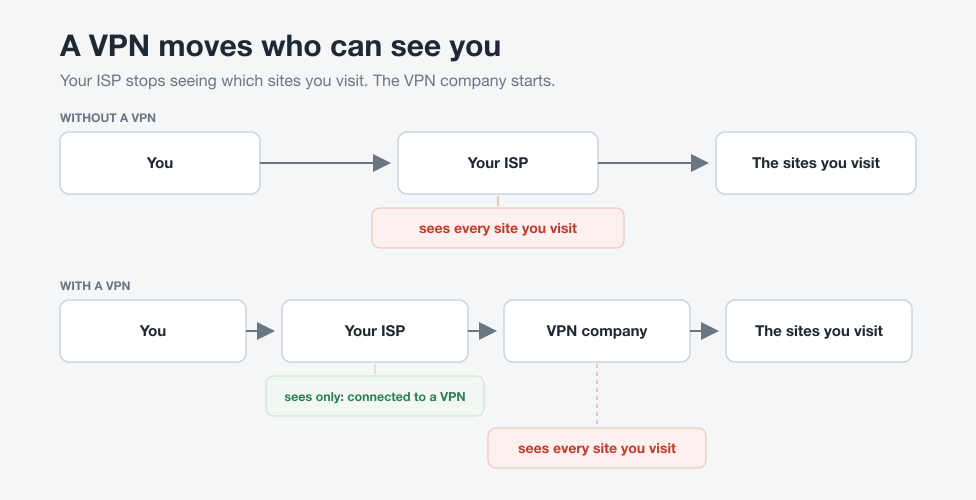
So the question stops being "does this make me invisible" and becomes "do I trust this company more than I trust my ISP". That's why the no-logs policy matters, and why it matters even more whether that policy has been independently audited. A company can put "no logs" on the homepage without it meaning anything. An audit by an outside firm that looked at the actual servers is a different thing. Surfshark also runs its servers from RAM only, so there is no disk for a log to sit on even if someone came asking, which is a stronger claim than a policy page.
Who should buy one
- People who travel a lot and spend time on hotel, airport, and café networks they don't control.
- People whose ISP sells browsing data, which US law has allowed since 2017.
- People who want to watch streaming content from another country.
- People working remotely from networks the company doesn't run.
If you decide you want one
If you are in one of the groups above, NordVPN and Surfshark are the two I would compare, and they have converged to the point where the comparison is short. Neither is really selling a VPN any more. Both lead with antivirus, scam and phishing protection, and ad blocking, with the VPN as one feature inside a security bundle.
Ignore the coverage numbers. Nord advertises 224 locations and Surfshark advertises 100 countries, which are different units. Nord is counting cities, so it is not 224 countries, and neither page gives you a figure you can hold against the other one.
What is left is devices and price. Surfshark puts no limit on how many devices a subscription covers, which is the difference if you are covering a family, and Nord caps it without saying so anywhere on its pricing page. Nord has the bigger network at 6,800 servers against 4,500, and the better-known name.
Whichever you pick, look at the renewal price and not the headline price. Nord was advertising $2.99 a month against an $11.59 list price when I wrote this, and that second number is what you pay in year two.
Who shouldn't bother
If you're on your own home wifi doing ordinary browsing, a VPN is buying you very little. Your ISP already sees your traffic and a VPN just hands that view to someone else. The sites you log into already know who you are. Your bank was already encrypted. For the home-wifi-and-Netflix crowd, the honest answer is you probably don't need one.